When There is Nothing to Compete For - Part 1
This book does not begin with Plato, Aristotle, Hobbes, Marx, or Rawls. Yet everything they struggled to understand lives quietly within its pages.
Loading...


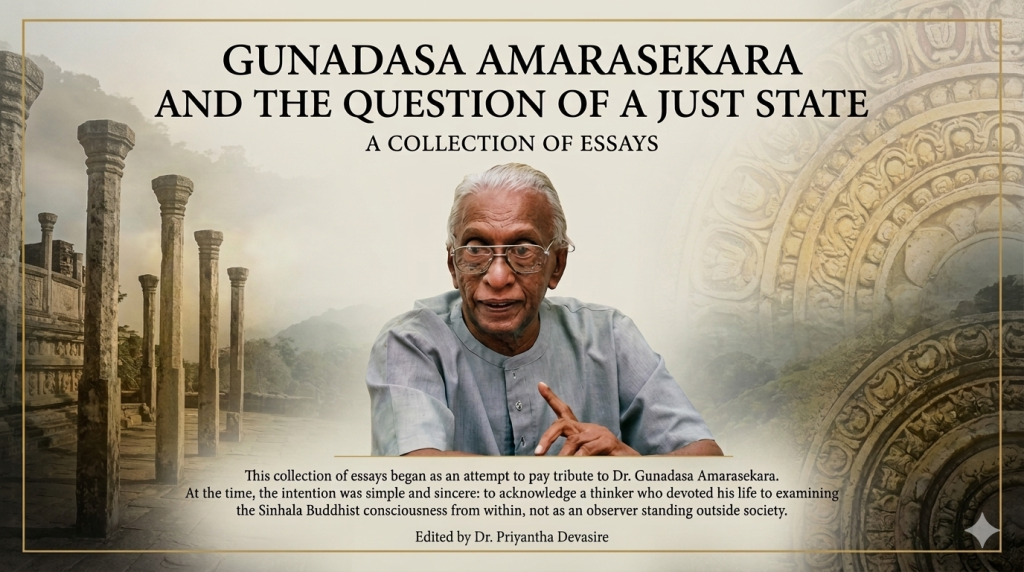
This collection of essays began as an attempt to pay tribute to Dr. Gunadasa Amarasekara. At the time, the intention was simple and sincere: to acknowledge a thinker who devoted his life to examining the Sinhala Buddhist consciousness from within, not as an observer standing outside society.
Gunadasa Amarasekara and the Question of a Just State
A reflective dialogue with Plato and Sinhala Buddhist consciousness
Contents
Preface
Chapter 1: The Unique Radical Core of Amarasekara’s Political Philosophy
This chapter uncovers the inner source of Amarasekera’s political thought, showing how his philosophy arises not from abstract theory but from a lived cultural and ethical consciousness rooted in Sinhala Buddhist experience.
Chapter 2: A Remarkable Convergence between Plato and Amarasekara
Here, two distant thinkers are brought into quiet dialogue, revealing how similar questions about justice, order, and the human condition lead to strikingly parallel visions across time and culture.
Chapter 3: Justice, Equality, and the Birth of a Moral Order
This chapter explores how ideas of justice and equality emerge not as legal inventions, but as moral necessities shaped by human vulnerability, restraint, and shared existence.
Chapter 4: Engaging the Critics: A Conversation Around Possibility
Rather than defending a position, this chapter opens a thoughtful conversation with critics, examining doubts, challenges, and misunderstandings to clarify what is truly at stake in imagining a just state.
Chapter 5: The Institutional Heart of Justice: From the Republic to the Sabyathva Rajya
This chapter examines how moral visions attempt to take institutional form, comparing Plato’s Republic with Amarasekera’s Sabyathva Rajya to reveal both their strength and their inherent tension.
Chapter 6: Carrying the Vision Forward
Attention shifts from the thinker to the reader, asking how a profound political vision continues to live, change, and challenge society beyond the lifetime of its creator.
Chapter 7: The Possibility of a Just State
This chapter asks whether justice can arise naturally rather than through force, and whether a political order can emerge from principle instead of design.
Chapter 8: The Subtle Limitation of a Profound Vision
The final chapter reflects on the boundary where deep insight meets the limits of system building, honouring Amarasekera’s achievement while gently revealing where political thought must step back and allow reflection to begin.
End Note
A Closing Reflection
Gunadasa Amarasekara and the Question of a Just State
A reflective dialogue with Plato and Sinhala Buddhist consciousness
Preface
This collection of essays began as an attempt to pay tribute to Dr. Gunadasa Amarasekara. At the time, the intention was simple and sincere: to acknowledge a thinker who devoted his life to examining the Sinhala Buddhist consciousness from within, not as an observer standing outside society, but as one who belonged to it fully and bore its burdens honestly. As the essays unfolded, however, it became clear that what was emerging was not merely a tribute, but a sustained philosophical engagement with Amarasekera’s political vision.
Amarasekara is not a thinker who can be approached lightly. His concept of Jathika Chinthanaya is not a slogan, nor a nostalgic attachment to the past, but a deeply considered attempt to understand the cultural, psychological, and historical foundations of a people. His idea of the Sabyathva Rajya grows from this foundation, shaped by decades of reflection, literary creation, and critical engagement with both Eastern and Western thought. To read him seriously is to be drawn into questions that do not allow easy answers.
As these essays developed, another presence gradually took shape alongside Amarasekara. Plato’s Republic emerged not by design, but by necessity. Whenever Amarasekara spoke of justice, order, virtue, or the role of the state, Plato appeared as a shadow against which his ideas could be clarified. The comparison is not intended to elevate one thinker over the other, nor to measure Amarasekara by foreign standards. Rather, Plato serves as a philosophical mirror, allowing us to see more clearly where Amarasekara converges with classical political thought and where he decisively departs from it.
What follows, therefore, is neither a systematic comparison nor an academic survey. These essays are reflective in nature. They move between philosophy, literature, history, and lived experience. Amarasekera’s novels, especially his long chronicle of social change through the life of Piyadasa, are treated not as supplementary material, but as an integral part of his political thinking. In them, the Sinhala Buddhist consciousness is not theorized from a distance but revealed through struggle, contradiction, failure, and endurance. To ignore this literary dimension would be to misunderstand the depth of his political vision.
At the same time, this work does not avoid difficult questions. While recognizing the originality and moral seriousness of Amarasekera’s project, the essays also examine its limitations. In particular, they reflect on the tension between a vision that arises from a non dual understanding of life and the rational, structural models proposed for political organization. This tension is not presented as a personal failure, but as a broader dilemma faced by all societies shaped by modern scientific rationality over the last several centuries.
These essays are written from within the Sinhala Buddhist world, not against it. They do not seek to dismiss Amarasekera’s achievements, nor to replace his vision with another ideology. Instead, they attempt to continue the conversation he began, guided by the conviction that political philosophy must ultimately align with the principles that govern human action, interdependence, and moral responsibility.
If this work succeeds, it will not be because it offers final answers, but because it keeps alive a question that matters deeply to our time: whether a just state can emerge naturally from the lived principles of a people, rather than being imposed through systems that remain disconnected from human conduct and consciousness.
That question, more than any conclusion, is the true tribute.
1. The Unique Radical Core of Amarasekara’s Political Philosophy
There are moments in the history of thought when a philosopher does not merely respond to his age but quietly steps outside it. Dr. Gunadasa Amarasekara belongs to this rare category. Though he is widely known in Sri Lanka as a writer, poet, and social thinker, the philosophical originality of his political vision has not yet received its proper place in the wider intellectual world. What makes his contribution exceptional is not simply the positions he takes, but the place from which he begins. He starts political thinking from a vision of human nature defined not by its weaknesses, but by its highest possibilities.
This choice alone marks a radical departure from both Marxism, which he consciously rejects, and from the dominant traditions of modern Western political thought. From Hobbes through Locke, Rousseau, Mill, Marx, and Rawls, political theory has generally begun with human beings as they appear in their ordinary condition. People are assumed to be acquisitive, competitive, fearful, or driven by desire, and the state is then designed as a mechanism to regulate, restrain, or correct these tendencies. Even when motivated by moral concern, such theories rest on the assumption that society must be engineered to manage a flawed majority.
Amarasekara reverses this entire logic.
He does not construct a political philosophy that accommodates greed, nor does he design an apparatus to discipline human weakness. Instead, he imagines a political order that becomes meaningful only when people awaken a higher dimension of their own nature. His approach is therefore not corrective, but aspirational. At the heart of his thought lies a simple yet demanding insight: a just society cannot arise from minds dominated by possessiveness and craving. It must emerge among people who are capable of living in the world without grasping at it, people whose inner dispositions are shaped by non-attachment.
This vision becomes clearer when we consider the influence of Erich Fromm on his thinking. Fromm, deeply informed by Buddhist moral psychology, distinguishes between two fundamental modes of existence. In the mode of having, the human being seeks to take, own, accumulate, and secure. In the mode of being, one participates in life with clarity and freedom, without the compulsion to possess. For Amarasekara, this distinction is not merely analytical. It is foundational. It affirms that human beings are not fixed in one psychological condition. Both possibilities exist within them, and the task of political philosophy is not to assume the worst, but to cultivate conditions that resonate with the best.
At this point, Amarasekara’s thought enters into a deep conversation with Buddhist insight. As explained by Bhikkhu Bodhi in his discussion of the Mahachattarisika Sutta, right view appears in two forms. One is worldly, bound to merit and attachment. The other is higher, oriented toward liberation and grounded in non-attachment. Amarasekara’s political vision resonates with this second form. It is not a religious prescription, nor a ritual framework, but an expression of civilizational consciousness. He understands the Sinhala Buddhist mind not merely as a sociological category, but as a reservoir of dispositions shaped over centuries by values of restraint, clarity, and non-grasping.
This is where Amarasekara stands apart from nearly every major thinker in political modernity. He does not begin with economic structures. He does not derive theory from the psychology of capitalist society. Nor does he rely on history alone to deduce political models. His approach rests on a deeper anthropological insight: a political order must be grounded in a conception of the human being that reflects his highest potential, not his lowest tendencies.
In this respect, he stands closer to Plato than to Marx or modern liberal theorists. Plato begins his political inquiry not from the turmoil of Athens or from the cynicism of the sophists, but from the calm life of Cephalus, a man who has lived without injustice, without unearned gain, and without fear of death. Though Socrates moves beyond Cephalus’ simplicity, Plato never abandons that starting point. The Republic is built on the assumption that a just state is possible only because the human soul itself is capable of harmony. Amarasekara, separated by centuries and culture, makes the same philosophical move. He begins not with the masses as they are, but with the human being who has loosened the grip of greed and ego.
This parallel is not accidental. It reflects an intellectual courage shared by very few thinkers. Both recognize that the political order is not merely a system for distributing power or managing resources. It is a reflection of the inner structure of human consciousness. A disordered mind produces a disordered society. A noble mind gives rise to a noble state.
From this foundation arise similar philosophical challenges, which will return throughout this work. If a state is grounded in virtue, how does it endure when many have not yet attained that virtue. If a political order reflects non-attachment, how does it avoid turning into moral coercion. And if the model is built on the highest in man, how do we prevent the lower tendencies from overwhelming it.
Yet despite these shared challenges, the outcome of Amarasekara’s thought remains uniquely his own. He does not imitate Plato. He develops a contemporary vision rooted in the lived history and inner psychology of the Sinhala Buddhist people. He is not constructing a utopia, but articulating a latent possibility within a civilization that has long carried the values of moderation and restraint.
That such originality remains largely confined within Sri Lanka is indeed a tragedy. Amarasekara’s intellect, equal in depth and subtlety to many globally celebrated thinkers, has yet to receive sustained international attention. Yet the conceptual core of his political philosophy secures his place among the rare few who imagine the state not as a response to human failure, but as a space in which the highest human potential may breathe.
2 A Remarkable Convergence between Plato and Amarasekara
There are thinkers who build their ideas in response to social conflict. There are thinkers who seek to correct human weakness. And then there are a very few who begin from a deeper question altogether: what is the highest nature of the human being, and how might a political order arise from that inner possibility. Plato belongs to this small group. Dr. Gunadasa Amarasekara belongs to it as well. Their worlds are distant in time, culture, and circumstance, yet they walk toward the same destination guided by the same first light.
To recognize this convergence is not to claim influence or imitation. Amarasekara does not continue Greek philosophy. Rather, both thinkers arrive independently at the same foundation from different civilizational paths. Plato opens The Republic with a quiet image that is easily overlooked: the composed mind of Cephalus, a man who has lived without harming others, without taking what is not his, without being tormented by excess desire. Plato presents this not as an argument, but as an intuition. It reveals that a balanced human life is possible without possession or domination.
Amarasekara reaches this same insight through a different route. His engagement with Erich Fromm’s distinction between having and being provides a conceptual language for something he has long observed. In the mode of having, the human being grasps and accumulates. In the mode of being, one lives freely and clearly without fastening oneself to objects or identities. Amarasekara recognizes in this distinction a precise expression of the inner psychology shaped by centuries of Buddhist influence among Sinhala Buddhists.
Yet his confidence in this vision does not arise from abstraction alone. It grows out of decades of close observation, literary exploration, and social reflection. Through novels, essays, and social critique, he studies how ordinary people struggle with desire, restraint, fear, generosity, and moral conflict. It is from this sustained engagement with lived reality that he identifies a cultural memory marked by contentment, moderation, and communal responsibility. Only then does he recognize in Fromm’s work a theoretical articulation of what he has already encountered in life.
For both Plato and Amarasekara, the conclusion is the same. The political order is an extension of the inner life. A society shaped by fear and craving will produce institutions of domination and conflict. A society guided by clarity and non-attachment will incline toward harmony and justice. This is why their political visions resemble one another despite their differences. Plato’s ideal of rule by wisdom rather than appetite finds a clear echo in Amarasekara’s vision of a civilizational state arising from moral consciousness rather than coercive power.
Both thinkers face the same enduring challenge. How can a state grounded in higher values survive when many remain caught in lower modes of desire? Plato answers through education and the cultivation of virtue, trusting reason to gradually reshape the soul. Amarasekara answers by pointing to cultural continuity. For him, moral consciousness is not imposed; it is carried, often unconsciously, through shared history, practices, and values. In both cases, law and punishment are insufficient. A mature and balanced consciousness is indispensable.
Their methods differ, but their aim converges. Plato builds through dialogue and metaphysical reflection. Amarasekara builds through civilizational psychology informed by Buddhist thought and modern humanistic insight. Plato speaks as a classical philosopher. Amarasekara speaks as a thinker rooted in the lived experience of his people.
The result is that both envision a state not as a technical apparatus, but as a way of life. Justice is not manufactured through policy. It grows from the kind of human beings a society nurtures. In this shared courage to begin from the highest possibility in man, they meet as equals.
And perhaps the clearest mark of Amarasekara’s originality lies here. He does not inherit Plato. He meets him at a point where great minds converge, arriving there through the wisdom embedded in his own civilization and through his profound understanding of the human soul.
3. Justice, Equality, and the Birth of a Moral Order
Across the long history of political thought, there are rare moments when distant minds echo one another without ever meeting. Plato and Amarasekara belong to this lineage. Though separated by centuries and cultures, they are awakened by the same question: what is a just life, what is a fair society, and what must a human being become so that justice is not merely proclaimed, but lived.
Plato enters this question through what appears to be a simple conversation with Cephalus, only to discover that justice cannot be defined without contradiction when it rests on opinion alone. Surrounded by competing claims of right and wrong, Socrates senses that something deeper is required. The Republic thus becomes an attempt to imagine a state in which justice is not enforced from outside, but arises naturally from the inner order of the soul.
Amarasekara begins elsewhere. He confronts a world fractured by inequality, exploitation, and distorted values that reward accumulation over dignity. His concern is not definition but restoration. The injustice he witnesses is concrete, lived, and painful. For him, equality cannot be achieved through policy alone. It requires liberation from attachment, because without inner freedom no system can restore balance.
Though their starting points differ, a convergence soon appears. Plato begins with the intuition that one must do what is right. Amarasekara begins with the insight that one must live without grasping. Both are moral beginnings that precede politics and institutions.
Plato’s just person is inwardly harmonious. Reason guides desire, spirit holds courage without aggression, and the soul is at peace. Justice flows effortlessly from such a life. Amarasekara’s detached person follows a different path but reaches the same ground. Freed from craving, one becomes clear, compassionate, and restrained. When one does not cling, one does not take what is not given.
From this shared insight emerges a profound political consequence. The world is no longer something to own, but something temporarily entrusted to us. This recognition softens greed and grounds responsibility. For both thinkers, the moral order arises from this vision.
Plato embodies it in the structure of his ideal city. Amarasekara carries it into a vision of socialism rooted not in redistribution alone, but in transformed desire. In both cases, the state becomes a guardian of balance rather than an arena of competing appetites.
At the furthest horizon of their thought lies a striking conclusion. When life is rightly ordered, justice dissolves. In Plato, it dissolves into harmony. In Amarasekara, into equality. Both arise from a life guided by restraint, awareness, and respect.
Though their voices emerge from different worlds, their insight is timeless. A just state cannot be built on law alone. It requires a transformation of the human heart. And in their convergence, we glimpse what a truly moral order might one day become.
4. Engaging the Critics: A Conversation Around Possibility
Every serious political vision invites disagreement. A philosophy that claims to speak to justice, human nature, and the ordering of society cannot avoid questions, doubts, and resistance. This is not a weakness. It is a sign that the idea is alive. The political visions of Plato and Gunadasa Amarasekara are no exception. Their shared trust in moral consciousness, their movement from inner clarity to social design, and their refusal to reduce politics to mere power or economics inevitably unsettle minds shaped by modern assumptions. Yet this encounter with criticism does not diminish their insights. On the contrary, it deepens them.
Three concerns arise repeatedly, and each deserves careful attention.
The first questions the practicality of grounding political life in morally awakened individuals. Modern political thinking often assumes that most people are driven by self-interest, fear, and desire, and that any workable system must be designed around these impulses. From this perspective, Plato and Amarasekara appear to be imagining societies fit only for rare moral elites rather than ordinary human beings. But this reading misses a crucial point. Neither thinker expects perfection. Plato does not imagine a city filled with flawless rational beings, and Amarasekara does not imagine a nation of enlightened saints. What both recognize is that every functioning society already depends on a moral foundation. Laws work only because people understand, at least dimly, why certain actions must not be done. Even those driven by selfish motives accept restraints when they see that unrestrained desire destroys communal life. Human history shows again and again that societies are guided, not by the moral perfection of the many, but by the clarity of a few and the moral comprehension of the rest. Plato and Amarasekara build on this enduring reality. They do not ask for sainthood. They ask for awareness and restraint, qualities that are already present, however unevenly, in every stable civilization.
The second critique claims that both thinkers detach themselves from history. Plato’s Republic is often dismissed as a timeless abstraction, unconcerned with the real evolution of states, conflicts, and institutions. Amarasekara, though more rooted in cultural experience, is also said to focus too heavily on consciousness rather than historical struggle or economic forces. This concern deserves respect, but it rests on a misunderstanding. Neither thinker attempts to escape history. They seek a vantage point from which history can be understood more clearly. Political events do not arise in a vacuum. They emerge from ways of seeing, desiring, and valuing that already exist within the human mind. Plato reads the soul to understand the city. Amarasekara reads cultural consciousness to understand society. Their focus on inner life is not historically naïve. It is historically foundational. By examining the enduring patterns of desire, fear, and restraint, they address the forces that give rise to every historical moment, not just one.
The third critique suggests that Amarasekara’s political vision depends on a level of detachment that ordinary people cannot achieve. This too misses the subtlety of his approach. Amarasekara does not treat detachment as an exalted spiritual state reserved for ascetics. He speaks of a reflective human being who understands the cost of blind ownership and unchecked craving. Such a person may still struggle with desire, but he is no longer ignorant of its consequences. This moral intelligence is not rare. It is part of ordinary life wherever people pause to reflect on the harm caused by excess, exploitation, and domination. Plato, in his own way, relies on the same capacity. His citizen is not perfectly rational, but capable of recognizing harmony and understanding why justice matters. Both thinkers trust the human mind not because it is flawless, but because it can learn.
Seen in this light, the critiques do not weaken their philosophies. They refine them. They remind us that political visions grounded in moral consciousness have always faced skepticism, yet they remain among the most enduring contributions to human thought. Plato and Amarasekara do not offer escapist ideals. They articulate possibilities rooted in the deepest structures of human life, possibilities that remain open even in imperfect societies.
5. The Institutional Heart of Justice: From the Republic to the Sabyathva Rajya
When political thought begins with moral consciousness, institutions do not arise from convenience or power alone. They take shape as expressions of inner order. This is why thinkers separated by centuries and civilizations sometimes arrive at strikingly similar political forms. Plato and Gunadasa Amarasekara are a powerful example of this convergence.
Plato’s inquiry begins with a deceptively simple question. What does it mean for a community to be just? Early answers collapse under examination, revealing contradictions and self-interest. This failure forces Plato toward a deeper insight. Justice is not merely an external rule. It is the harmonious ordering of the soul. Once this is seen, the city must be designed as a reflection of that inner harmony. The Republic is born not from political ambition, but from moral insight.
Amarasekara begins elsewhere, within a civilizational consciousness shaped by the Buddha’s teaching. His concern is not to define justice through argument, but to understand how a society can live without being consumed by grasping and attachment. For him, the foundation of political life is the ordinary individual who has learned, through experience and reflection, the meaning of restraint. Such a person is not free from weakness, but is no longer blind to it. From this awareness grows the vision of the Sabyathva Rajya.
Despite their different starting points, both thinkers face the same challenge. Moral insight alone cannot sustain a community. It must be embodied in institutions that protect and express it. Here, the parallels become unmistakable.
Plato designs a city structured in three parts, mirroring the soul itself. At the summit stands the philosopher king, not as a ruler of domination, but as a guardian of wisdom. Below him stand the guardians, disciplined protectors who act with courage and loyalty to justice. At the foundation are the producers, whose work sustains the life of the city. The structure is psychological before it is political. Each role corresponds to a dimension of the human being, aligned in harmony.
Amarasekara articulates a similar triadic order drawn from Buddhist civilizational history. At the moral apex stands the Sangha, not as a theocratic authority, but as the living presence of insight into impermanence, nonattachment, and compassion. The king functions as the executor of this moral vision, a custodian of justice rather than a seeker of power. The people form the foundation, bound together by a cultural consciousness that values restraint and mutual responsibility. Together, they create a moral ecosystem rather than a mechanical state.
When historical details are set aside, the deeper symmetry emerges. Plato’s philosopher king finds a parallel in the Sangha as a source of guiding wisdom. His guardian class echoes in the righteous ruler who protects and enforces moral order. The producing citizens of the Republic reflect the people whose shared values sustain the Sabyathva Rajya. This symmetry is not accidental. It arises whenever political thought begins with the ordering of the inner life.
Both visions remind us that justice cannot be manufactured through laws alone. It must be lived through institutions that reflect moral truth. In both, governance grows from character rather than calculation. This is the quiet bridge between Athens and the Buddhist civilization that shaped Amarasekara’s imagination, a bridge built not by imitation, but by shared insight.
6. Carrying the Vision Forward
Some books never lose their relevance. They endure not because they were perfectly realized in history, but because they continue to ask questions human beings cannot abandon. Plato’s Republic is one such work. For over two thousand years, it has shaped political thought, challenged assumptions, and invited each generation to reconsider justice, power, and the human soul. No state ever implemented it fully, yet its influence has been immense. It survived as a conversation rather than a constitution.
Sabyathva Rajya carries a different destiny. Born in a small linguistic and cultural space, it did not travel easily beyond its borders. Yet its roots run deep, drawing nourishment from the Buddha’s teaching, the moral imagination of Buddhist civilization, and the lived experiences of communal life in Sri Lanka’s past. Amarasekara did not invent his vision from abstraction alone. He recognized fragments of it in history, in village councils, in ethical traditions, and in the Asokan spirit of governance. Long before modern scholars studied community based resource management, such practices existed here, imperfect yet meaningful.
The tragedy is not that Sabyathva Rajya has critics. Every serious idea does. The real danger is that it may fade simply because it was not carried forward. Great ideas do not survive by merit alone. They survive because generations feel responsible for them. Greece was once a small land as well. Its size did not prevent its thought from shaping the world.
If Plato’s Republic lived through centuries because scholars, teachers, and readers kept returning to it, the same possibility exists for Amarasekara’s vision. But that future depends on whether we treat Sabyathva Rajya as a private argument or as a body of thought worthy of preservation, discussion, and development.
Ideas endure only when someone chooses to carry them. If we choose to carry this one, it may yet speak beyond its time and place. And if it does, it will not be as a forgotten local experiment, but as a contribution to humanity’s ongoing search for justice, dignity, and a political order rooted in the depth of human consciousness.
7. The Possibility of a Just State
Some political works survive not because they were ever implemented, but because they preserve a question that humanity cannot afford to forget. Plato’s Republic is one such work. No city ever lived under philosopher kings, and no society ever achieved the perfect harmony of classes that Plato imagined. Yet the book has never disappeared. It has travelled across centuries, languages, and civilizations because it keeps alive a single, unsettling question. What would a just state look like if it were built upon a just human being?
Gunadasa Amarasekara’s Sabhyathva Rajya belongs to this same lineage of inquiry. It does not offer a program for immediate political action, nor does it flatter the instincts of power. Instead, it asks a deeper question that modern politics often avoids. What kind of human consciousness must exist before a just political order can emerge? In doing so, Amarasekara places himself in conversation not only with Plato, but with the entire tradition of political philosophy that treats morality as the hidden foundation of governance.
The point of comparison between Plato and Amarasekara is therefore not institutional design. It is the nucleus from which their political visions grow. Plato begins the Republic not with laws or rulers, but with Cephalus, an old man who has lived long enough to understand the quiet value of justice. Cephalus is not a philosopher and not a hero. He represents moral balance, a life free from the fear that comes with wrongdoing. Plato does not interrogate this figure at length. He allows him to withdraw gently from the dialogue, leaving behind an image of inner harmony that silently governs everything that follows. From this moral intuition, Plato constructs an ideal city meant to protect and reproduce such a soul.
Amarasekera’s starting point is far more demanding. He does not encounter his nucleus in a single figure or a moment of dialogue. He arrives at it through decades of observation, reflection, and literary creation. His understanding of the Sinhala Buddhist consciousness is not derived from theory alone, but from a sustained engagement with lived human experience. Through his novels, he traces how ordinary people think, suffer, desire, restrain themselves, compromise, and sometimes awaken. These literary works are not decorative additions to his political philosophy. They are the ground from which it arises.
The long chronicle of novels centered on the character Piyadasa, spanning nearly seventy years of Sri Lankan life, functions as a continuous study of moral consciousness under changing historical conditions. Colonial residue, nationalist hope, socialist idealism, political disillusionment, and quiet endurance all pass through this single life and those around it. In this process, Amarasekara does not invent a moral type. He discovers one. The Sinhala Buddhist person he describes is neither saintly nor corrupt by nature. He is burdened with weakness and desire, yet capable of restraint, reflection, and non attachment when conditions allow.
It is through this long literary labour that Amarasekara arrives at what he later names Jathika Chinthanaya. This is not nationalism in the narrow or ideological sense. It is the moment when a collective moral consciousness, long carried unconsciously, rises into reflective awareness. Amarasekera’s engagement with Erich Fromm’s distinction between having and being follows naturally from this discovery. He recognizes in Fromm’s language a truth he has already encountered repeatedly in Sinhala Buddhist life. His political philosophy therefore grows outward from cultural psychology, not upward from rational abstraction.
This difference reveals both the strength and the boundary of his vision. Plato’s Republic is magnificent, but it floats above history. It has no cultural memory and no psychological anatomy. Its justice is timeless, but disembodied. Amarasekera’s Sabhyathva Rajya, by contrast, rises from a living continuum. It carries traces of historical experience, from village councils to ethical kingship, from communal stewardship of land to a moral economy shaped by Buddhist values. These traces do not prove the success of his vision, but they show that it is not imagined in isolation from reality.
Yet here we encounter the subtle limitation that both thinkers share, despite their differences. After reaching a profound moral insight, both Plato and Amarasekara turn toward rational system building. Plato designs a city to protect moral harmony. Amarasekara outlines a political structure meant to sustain a culturally grounded ethical consciousness. In doing so, both remain within the familiar frame of political philosophy, where the thinker stands outside the system and designs it for society.
This is not a failure of intelligence or sincerity. It is a limitation inherited from the very tradition of rational political thought that has shaped philosophy for centuries. Once the moral subject is defined, the philosopher feels compelled to create a system that will preserve it. The city becomes a container for virtue. Politics becomes an instrument for safeguarding morality.
The consequence is subtle but significant. The political vision becomes something that must be introduced, maintained, or even enforced, rather than something that flows naturally from an underlying principle governing action itself. In Amarasekera’s case, this leads to a structure that, while deeply ethical and culturally intelligent, still resembles earlier philosophical cities, including Plato’s, in its reliance on institutional guardianship.
This is why Sabhyathva Rajya, like the Republic, stands most securely as a philosophical work rather than a ready political model. Its value lies not in immediate implementation, but in its capacity to preserve the possibility of a just state by keeping moral inquiry alive. Amarasekera’s achievement is not that he solved the problem of politics, but that he brought political thought closer to the soil of lived human consciousness than most thinkers before him.
To read Amarasekara without his novels is to misunderstand him. His political philosophy cannot be separated from his literary exploration of the Sinhala Buddhist mind, just as Plato’s philosophy cannot be separated from the dramatic form of dialogue through which it speaks. In both cases, philosophy lives not only in argument, but in character, memory, silence, and moral tension.
The possibility of a just state does not arise from perfect institutions or flawless rulers. It arises when a society recognizes the conditions under which human beings are capable of restraint, responsibility, and care for more than themselves. Plato preserved that question for the world. Amarasekara preserved it for a people who had almost forgotten that they already carried part of the answer within them.
If such works endure, it will not be because they were imposed on history, but because future minds recognized their necessity. Justice does not survive by force. It survives because someone refuses to let the question disappear.
8. The Subtle Limitation of a Profound Vision
Dr. Gunadasa Amarasekera’s political thought reaches a depth rarely seen in modern political philosophy. His concept of Jathika Chinthanaya, or National Consciousness, is not a slogan, nor a mere cultural assertion. It is the outcome of a lifetime of engagement with the lived reality of the Sinhala Buddhist people, observed through history, literature, and society itself. In this sense, his work stands far apart from abstract political systems constructed purely through rational deduction.
The idea of a collective consciousness is not unique to Amarasekara. Thinkers such as Samuel Huntington speak of civilizations shaped by deep cultural patterns that operate beneath surface politics. Yet Amarasekara arrives at a similar insight independently and takes it further. His Sinhala Buddhist Jathika Chinthanaya is not only cultural but psychological and ethical. It describes a way of being in the world, shaped by values of moderation, contentment, restraint, and communal responsibility.
What gives this idea its strength is the method through which Amarasekara arrives at it. His conclusions are not imposed from theory onto society. They are drawn from society itself. His vast body of literary work, especially the long chronicle of novels centered on the character Piyadasa, is not merely creative writing. It is a sustained sociological and psychological study spanning nearly seven decades of Sri Lankan life. Through these characters and their struggles, Amarasekara examines how Sinhala Buddhist consciousness responds to colonialism, modernity, moral decline, aspiration, failure, and endurance.
In this sense, his novels are not supplementary to his political philosophy. They are foundational. They are the soil from which his political ideas grow. Without understanding this literary exploration of the Sinhala Buddhist psyche, one cannot fully grasp the philosophical grounding of the Sabhyathva Rajya.
Through this deep engagement with lived experience, Amarasekara arrives at a conception of the Sinhala Buddhist that closely aligns with Erich Fromm’s distinction between modes of being and having. The Sinhala Buddhist, as Amarasekara understands him, inclines naturally toward being rather than possession, toward sufficiency rather than accumulation. This is not a romantic claim. It is an observation grounded in history, culture, and psychology.
Yet here lies a subtle and important limitation in Amarasekera’s political thought.
While he defines this human type with remarkable accuracy, he does not fully articulate the underlying principle that explains why such a consciousness arises. The deeper reason lies in the Buddhist understanding of reality itself, the insight into impermanence, interdependence, and continuous change. It is this unconscious familiarity with the interconnected nature of existence that shapes the Sinhala Buddhist disposition toward moderation and restraint.
Amarasekara clearly understands this principle. It is present throughout his intellectual and literary work. Yet when he moves from defining consciousness to constructing political theory, he shifts into the role of a rational system builder. At this point, the principle of interdependent interconnectedness no longer operates from within the system itself but is assumed from outside it.
As a result, his political vision remains largely confined to human society. Nature, other beings, and future generations are considered, but they are not structurally embedded into the political principle itself. The theory speaks from a position slightly outside the totality it seeks to govern.
This shift has significant consequences. Once the thinker stands outside the system, even with the best intentions, the task becomes one of designing institutions to guide society. In doing so, Amarasekara finds himself walking a path familiar to political philosophy since Plato. Like Plato’s Republic, the Sabhyathva Rajya becomes a beautiful, coherent, and morally elevated vision that must rely on carefully structured authority and guidance to sustain itself.
This is not a failure. It is a limitation shared by almost all great political philosophies. Plato constructed his ideal state from the standpoint of reason, aiming to educate and govern imperfect human beings. Amarasekara goes much further by grounding his vision in lived cultural and psychological reality. Yet the moment political theory becomes system building, the thinker inevitably stands apart from the system, shaping it rather than arising within it.
This is why the Sabhyathva Rajya, like Plato’s Republic, stands today as a profound philosophical achievement rather than a directly adoptable political model. Its value lies not in immediate implementation but in its capacity to guide thought, shape ethical reflection, and challenge shallow political imagination.
Seen in this light, Amarasekera’s political philosophy should not be diminished because it shares this fate with Plato. On the contrary, it joins the highest tradition of political thought, works that do not age because they are meant to be argued with, refined, and re understood by each generation.
The Sabhyathva Rajya remains an invaluable intellectual inheritance. It is a handbook for serious thinkers, not a policy manual for instant governance. Like The Republic, it invites society to ask deeper questions about who we are, how we live, and what kind of state is worthy of human dignity.
That invitation alone secures Dr. Gunadasa Amarasekera’s place among the great political thinkers of history.
End Note
In one of his most recent works, published only days ago, Dr. Gunadasa Amarasekera makes a candid and courageous admission. He acknowledges that his political project remains incomplete, not because its philosophical foundations are weak, but because he has not shown a clear and workable path by which the Sabhyathva Rajya could emerge as a practical alternative to the political and economic order that governs us today. In making this admission, he refers to my own work Arya Rajya Kara and notes that I was, to his knowledge, the only critic who explicitly pointed out this absence. He also states that he agrees with this observation.
I record this not as a personal achievement, but as an indication of Amarasekera’s intellectual honesty. Very few thinkers of his stature are willing to acknowledge a limitation in their own work so openly, especially at this stage of life. It confirms once again that his political thinking was never driven by pride or dogma, but by a genuine concern for the future of society.
Where I part ways with Amarasekara is not in his diagnosis, nor in the moral urgency that animates his work, but in the direction of the correction he proposes. His model of the Sabhyathva Rajya is a sincere attempt to secure sustainability, harmony, and moral restraint by looking at society through the lens of Jathika Chinthanaya. Yet, precisely because this national consciousness is something that operates beyond mere rational calculation, the moment it is translated into an institutional design, it is forced back into a rational framework.
The triadic structure he proposes, consisting of the Maha Sangha, the Buddhist king, and the people organized through village councils, reflects this tension. While this arrangement draws strength and legitimacy from historical memory, it remains a system constructed from outside the living principle it seeks to protect. All three components of the triad are composed of human beings who are subject to fear, desire, attachment, and error. None of them can be permanently assumed to act as the mature, balanced beings described by Erich Fromm. As a result, even if such a system were successfully implemented, its endurance would depend heavily on exceptional individuals rather than on the natural stability of the principle itself.
Amarasekara often turns to history to support his proposal, pointing to figures such as Ashoka, Pandukabhaya, and later Buddhist kings, as well as to institutional practices that existed before colonial intervention. While these references are valuable and illuminating, they cannot, by themselves, justify replacing the contemporary political order with a revived historical form. Historical success does not automatically guarantee future viability, especially when the underlying conditions of consciousness, economy, and global interdependence have changed so profoundly.
It is important to state clearly that Amarasekera’s rejection of the Westminster parliamentary system, party politics, and unrestrained capitalist democracy is not born of anger or nostalgia. His critique is careful, reasoned, and supported by history, philosophy, and modern political thought. His frustration is moral rather than emotional. He believes that Sri Lanka missed several opportunities during the last century to free itself from imposed political forms and return to a system more aligned with its cultural consciousness.
Yet, the deeper question remains whether the fundamental problem lies in the political system itself or in the principle upon which any system is built. It is here that my disagreement begins. Political forms, whether inherited or revived, tend to fail not because they are foreign or ancient, but because they are constructed without anchoring themselves in a principle that naturally governs human behavior within an interconnected and interdependent world.
If sustainability, justice, and restraint are to arise organically rather than by force, they cannot be imposed through institutions alone. They must flow from a principle that makes exploitation, excess, and domination irrational at their very root. Only when such a principle is recognized does the political order cease to be something imposed on society and become something that emerges from it.
This observation is not meant to diminish Amarasekera’s contribution. On the contrary, it is because his diagnosis is so profound, and his understanding of the Sinhala Buddhist consciousness so refined, that this limitation becomes visible. Like Plato before him, he brought political thought to its highest philosophical clarity within the walls of the city. That achievement alone ensures that his work will continue to educate, challenge, and inspire generations to come.
In reflecting on the unfinished nature of Amarasekera’s political project, one is led not toward disappointment, but toward a deeper question. Perhaps the difficulty does not lie in the absence of a final institutional design, but in the limits of institutional thinking itself. When a political philosophy reaches a certain depth, the problem may no longer be how to construct a better system, but how to recognize a principle that people already live by, often without naming it.
In my own work, I have argued that it is precisely for this reason that the idea of a Arya Rajya (noble state) is not alien to Sinhala Buddhists. It is not something to be taught, imposed, or introduced from outside. It is something already known, though rarely articulated. In this sense, my thinking meets Amarasekera’s understanding of Sinhala Buddhist consciousness at a fundamental level. Both arise from the recognition that a society shaped by impermanence, restraint, and interdependence does not require grand ideological inventions, but clarity about what it already understands.
Where the path quietly diverges is in the point at which reflection turns into construction. The moment a political vision seeks to stabilize itself through defined roles, recognized authorities, or inherited identities, it risks reentering the very realm of control and correction that it set out to transcend. History shows that even the most refined moral structures begin to decay when they rely on particular persons or privileged positions.
There is another way of seeing political order, one that does not ask who governs, who belongs, or who deserves recognition. It asks only how actions arise and what they disturb. In such a view, it is not the individual, the group, or the tradition that stands at the centre, but conduct itself. Harmful action matters, not the identity of the actor. Beneficial action matters, not the label carried by the citizen.
When action alone becomes the focus, distinctions of race, religion, language, and status lose their political weight. Harmony is no longer maintained by privileging a moral group or a cultural majority, but by ensuring that no action violates what is not freely given. Order emerges not because people are forced to be better than they are, but because the principle itself leaves no space for excess, domination, or ownership over what belongs to all.
This way of thinking does not deny culture, history, or consciousness. It honours them by refusing to turn them into instruments of power. It allows different traditions to recognize the same truth in their own language, without demanding uniformity. It does not replace Amarasekera’s vision, nor does it complete it. It simply steps back from the task of building and asks whether the world might already be ordered, if only we stop taking what was never given.
Seen in this light, Amarasekera’s work remains what it truly is: not a failed blueprint, but a profound mirror held up to a society struggling to remember itself. Like Plato before him, he reminds us that political thought reaches its highest point not when it commands the world, but when it reveals the limits of command.

This book does not begin with Plato, Aristotle, Hobbes, Marx, or Rawls. Yet everything they struggled to understand lives quietly within its pages.