INTRODUCTION
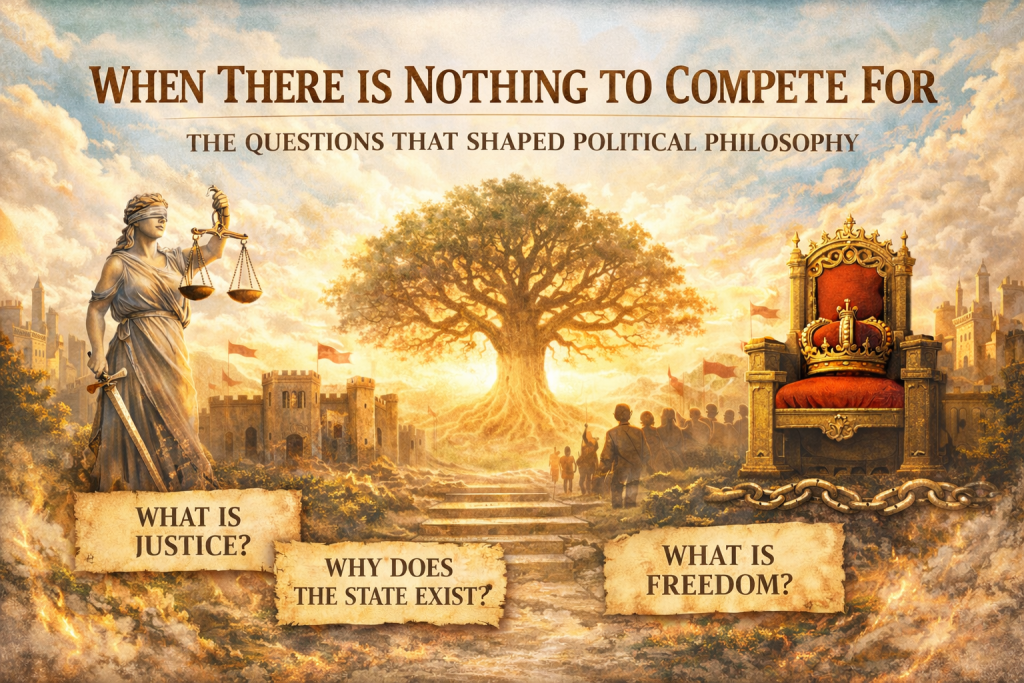
This book does not begin with Plato, Aristotle, Hobbes, Marx, or Rawls. Yet everything they struggled to understand lives quietly within its pages.
For centuries, political philosophy has asked the same questions in different forms. What is justice. What is freedom. What does the state exist for. How should power be limited. Each generation answered using its own language, its own fears, its own hopes. Brilliant minds built systems. Equally brilliant minds dismantled them. The debate continued.
What is striking is not that these thinkers disagreed. It is that they all reasoned within the same frame. Man stood apart from nature. Society appeared as a collection of competing interests. Progress meant control. Justice meant fair distribution of what was already claimed.
These ideas became systems. Systems became institutions. Institutions became unquestionable. And life, slowly, became unlivable.
Buddhist thought approached the problem from a different direction, not as political design but as lived understanding. It did not begin with the state or the individual, but with experience itself. Interdependence was not a theory. It was observable fact. Harm was not moral failure alone. It was imbalance. Freedom was not the right to take, but the wisdom to refrain.
Yet even this understanding rarely crossed into political life. It remained personal, spiritual, or ethical. The state continued to operate on separation, even in societies shaped by Buddhist culture.
What you are about to read is not an attempt to merge political philosophy with Buddhism, nor to challenge Western thought with Eastern thought. It does something simpler and more difficult. It steps aside from inherited frameworks and asks what people already know through living.
Sri Lanka offers a painful clarity here. A few years ago, the youth of this country went to the streets calling for system change. They were not wrong. They were precise in their suffering, honest in their anger, and courageous in their action. What they lacked was not sincerity, but articulation. They knew the system was broken, but they had no shared understanding of what a different system actually meant.
What followed was inevitable. The system remained. Only the faces changed. The frustration deepened.
Most people still believe systems are complex things understood only by experts, economists, lawyers, or politicians. In truth, every system rests on a small number of assumptions about human behaviour. Change those assumptions, and the system changes naturally. Leave them untouched, and nothing truly changes at all.
The essays in this book do not argue. They observe. They do not persuade through theory. They speak to recognition. They are written for ordinary people, because it is ordinary people who carry the cost of failed systems, and because the truth they point to is already understood at an ordinary level.
This is not a call for rebellion. It is a call for clarity.
When clarity arises, a system no longer needs to be overthrown. It simply becomes impossible to defend.
PART ONE
Why the Constitution Is Not the Answer We Are Looking For
Once again, the constitution has become the center of public debate. Political leaders speak of new constitutions, major amendments, or selective reforms as if the country’s present suffering and its future anxieties can be resolved through legal redesign. Many citizens have come to believe that if only the “right” constitution is adopted, the country will finally move onto the correct path.
This belief, however sincere, is misplaced.
Sri Lanka already possesses a complete political and administrative framework. There is a democratically elected executive president, a parliament chosen by the people, and a judiciary that commands respect both locally and internationally. From a structural point of view, the state is not broken. Elections are held, laws are enacted, courts function, and public administration continues. Yet dissatisfaction is widespread. People across regions, professions, and generations feel that something is deeply wrong.
If the problem were truly constitutional, its effects would be visible in clear institutional breakdowns. Conflicting authorities, legal paralysis, or the absence of accountability would point directly to specific defects that could be corrected. Administrative structures, like constitutions, are visible mechanisms. When they fail, we can see where and how they fail. They can be repaired, refined, or redesigned.
What we are facing today is different.
The problem lies not in the visible structure, but in the invisible system that operates through it. A system that shape incentives, reward certain behavior, tolerates others, and quietly discourage responsibility. It determines how power is used rather than who holds it. When a system is faulty, even well-designed institutions begin to produce harmful outcomes, not because individuals are immoral, but because they are responding rationally to a distorted environment.
This explains why changing leaders, rearranging powers, or amending clauses has repeatedly failed to bring lasting relief. We have been treating symptoms while leaving the cause untouched.
Historically, the last true system change in this country occurred nearly two centuries ago, during the Colebrook Cameron reforms under British colonial rule. Those reforms did far more than reorganize administration. They implanted a political and economic system rooted in utilitarian thinking and strong central control, designed to serve the needs of a colonial power. Efficiency, revenue extraction, and centralized authority were its priorities, not ethical coherence or long-term social balance.
After independence in 1948, political control changed hands, but the system itself remained largely intact. Successive governments modified it to address immediate problems, electoral pressures, or crises. These were adjustments, not transformations. The underlying logic of governance continued unchanged, even as the country and the world around it evolved.
This is why constitutional debates keep returning without resolution. People sense that the existing order is failing them, but they look for answers only where answers are most visible. The constitution becomes a convenient target because it is tangible and familiar. Systems, by contrast, are harder to name and even harder to confront.
There is also a widespread belief that wealthy countries prosper because their constitutions are superior. This too is a misunderstanding. Prosperity often masks suffering rather than eliminates it. In many rich societies, social fragmentation, inequality, environmental destruction, and psychological distress exist beneath the surface. Wealth reduces the visibility of pain, not its existence. Their constitutions manage outcomes efficiently, but they do not prevent systemic harm.
When we imitate constitutional forms without questioning the systems they serve, we import the same contradictions while lacking the economic buffers that hide their effects.
A healthy system can function through almost any administrative structure. A sick system will corrupt even the most elegant constitution. What we currently have is a weakened system, repeatedly patched and reinforced, but never healed. Each reform adds another layer, increasing complexity while avoiding the deeper question of direction.
The future, people hope for cannot be delivered by constitutional engineering alone. It can only emerge from a system that aligns power, responsibility, and restraint. Until we shift our attention from structures to systems, we will continue to walk with great confidence in the wrong direction, believing that movement itself is progress.
The real challenge before the country is not to decide which constitution to write, but to ask a far more uncomfortable question: what system are we living under, and why does it keep producing the same dissatisfaction regardless of who governs.
Only when that question enters public consciousness will meaningful change become possible.
01.1 Why Are We Unhappy When Everything Seems to Be in Place?
We live in a country where the basic machinery of the state is functioning. We elect a president. We elect a parliament. Laws are debated and passed. Courts sit in judgment and their decisions are respected. Government offices open every morning and close every evening. On paper, nothing appears to be fundamentally broken.
Yet, almost everyone is unhappy.
This unhappiness is not limited to one group or one ideology. Farmers feel abandoned. Professionals feel trapped. Young people feel their future slipping away. Even those in positions of power often appear anxious and defensive. The feeling cuts across class, ethnicity, and political loyalty. It is a shared discomfort, though rarely expressed in the same words.
This creates a simple but troubling question. If the institutions are working, why do the outcomes feel so wrong?
When a machine fails visibly, we know where to look. If a wheel is broken, it can be replaced. If a law is unjust, it can be amended. If an office is inefficient, procedures can be corrected. These are visible problems, and societies have always known how to deal with them.
What we are experiencing today does not fit that pattern. There is no single law that explains the frustration. No single institution that can be blamed. No single group that can be removed to restore balance. Even when governments change, the feeling remains. Hope rises briefly, then fades again, leaving behind a deeper sense of exhaustion.
This suggests that the source of our unhappiness lies deeper than individual failures or institutional flaws. It points to something that operates quietly, shaping decisions, rewarding certain behaviors, and discouraging others, without ever appearing on a ballot paper or in a legal clause.
Many people sense this but struggle to name it. As a result, attention turns to what is most visible. Constitutions, leaders, and administrative structures become the focus of anger and expectation. We argue about them because we can see them. But visibility does not always mean causality.
Until we pause to understand why functioning institutions can coexist with widespread dissatisfaction, we risk mistaking movement for progress. We keep repairing parts of a machine without asking whether it is designed to take us where we want to go.
01.2 What We See and What Actually Governs Us
When something goes wrong in our daily life, our instinct is to look for a visible cause. If a bus is late, we blame the driver. If a hospital fails, we blame the staff. If the country struggles, we blame politicians, laws, or the constitution. Visibility gives us comfort because it gives us something to point at.
But not everything that governs our life is visible.
Think of traffic. The roads, vehicles, and signals are visible structures. But the behavior of drivers is shaped less by the road itself and more by the system behind it. The rules, the enforcement, the penalties, and even what people believe they can get away with. Two cities can have similar roads and vehicles, yet feel completely different to drive in. The difference is not the structure. It is the system.
The same applies to a country. A constitution is a structure. Parliament, the presidency, ministries, courts, and public offices are structures. They define roles, powers, and procedures. When they malfunction, we can see it clearly. Overlapping authority, delays, conflicts, and inefficiency are all visible and correctable.
A system is different.
A system quietly shapes behavior within those structures. It decides what is rewarded and what is punished. It encourages certain actions and discourages others, often without any written instruction. Over time, people stop asking what is right and start asking what works within that system.
This is why two countries with similar constitutional arrangements can produce very different outcomes. It is also why changing leaders or laws often brings temporary relief but not lasting change. The same patterns return because the same system continues to operate beneath the surface.
When people say, “Everyone is corrupt,” or “Nothing changes no matter who comes to power,” they are unknowingly describing a system at work. Individuals come and go, but the logic that governs decisions remains untouched. Even well-intentioned people begin to behave in ways they never imagined, simply to survive or succeed within that logic.
This is also why focusing only on administrative reform feels exhausting. We keep fixing what we can see, while the unseen continues to steer outcomes. It is like repainting a house again and again without realizing that the foundation itself is misaligned.
Understanding this distinction is not about blaming institutions or individuals. It is about recognizing where real power lies. Not always in offices or laws, but in the invisible rules that shape choices long before a decision is made.
Once this distinction becomes clear, the conversation changes. We stop asking only how to rearrange structures and begin asking a deeper question. What kind of system is silently governing us, and is it capable of taking us where we hope to go.
01.3 How Systems Survive While Rulers Change
History teaches us something quietly but relentlessly. Governments change, leaders come and go, laws are amended, and constitutions are rewritten. Yet certain patterns remain stubbornly familiar. The language changes, the faces change, even the promises change, but the outcomes often feel strangely repetitive.
This happens because systems have a longer life than rulers.
A system does not announce itself. It does not campaign for votes or issue press releases. It embeds itself in routines, incentives, and habits. Once embedded, it begins to govern behavior almost automatically. People entering the system adjust themselves to it, often without realizing they are doing so.
This is why a newly elected government, full of energy and good intentions, often begins to resemble its predecessor within a short time. It is not always because ideals were false. More often, it is because the system quietly reshapes those ideals to fit its own logic.
Sri Lanka’s modern experience offers a clear example of this. Nearly two hundred years ago, during colonial rule, a comprehensive set of reforms reorganized administration, finance, and governance. These reforms were designed for efficiency, control, and predictability. They worked well for the purpose they were created for.
What is rarely acknowledged is that this was not just administrative change. It was a system change.
When independence arrived, political authority changed hands, but the inherited system remained largely intact. Over time, it was modified, adjusted, and expanded to meet new demands. Yet its core logic was never seriously questioned. What had once been designed to serve an external ruler slowly became normalized as the natural way of governing ourselves.
This is not unique to Sri Lanka. It is how inherited systems work everywhere. They become invisible precisely because they are familiar. People born into them assume that this is simply how things are done. Alternatives feel unrealistic, even dangerous, not because they are wrong, but because they are unfamiliar.
This also explains why reform often feels frustrating. We expect new results from old logic. We change the operators but keep the operating system. When outcomes disappoint us again and again, we blame individuals, corruption, or incompetence, without realizing that the system itself is quietly guiding behavior in predictable ways.
Understanding that systems outlive rulers is not about assigning blame to the past. It is about recognizing inheritance. Once we see that what governs us today was shaped for a very different purpose in a very different time, a new kind of question becomes possible. Not who failed, but what we are still carrying without noticing.
This realization is uncomfortable, but it is also liberating. Because what was inherited without choice can be examined consciously. And what can be examined can, in time, be changed.
01.4 Why We Mistake Wealth for Wisdom
When we look at wealthy countries, we often do so with admiration mixed with longing. Their cities appear orderly, their institutions stable, and their public services reliable. It is easy to conclude that their success must be the result of superior constitutions or better designed systems of governance.
This conclusion feels logical, but it is not entirely true.
Wealth has a powerful effect. It absorbs shocks, smooths failures, and delays consequences. When resources are abundant, mistakes do not immediately turn into visible suffering. Inequality can exist without erupting into unrest. Environmental damage can be postponed or exported. Social tensions can be softened through consumption, welfare, or distraction.
This does not mean that suffering is absent. It means that it is less visible.
In many wealthy societies, deep problems exist beneath the surface. Loneliness, mental distress, social fragmentation, and loss of meaning are widespread. Environmental degradation continues, often far from where the benefits are enjoyed. The costs are shifted to other regions, other communities, or future generations.
Constitutions in these countries do not prevent these outcomes. They manage them. They organize power efficiently within a system that continues to demand growth, extraction, and consumption. Because the system is supported by wealth, its harmful effects appear distant or manageable.
This is where misunderstanding arises in countries like ours. We observe the visible order and assume it is the result of superior legal design. We then attempt to copy constitutional forms, administrative practices, or institutional arrangements, hoping they will produce the same results.
But forms cannot replace foundations.
When the same system is adopted without the economic buffers that hide its consequences, its weaknesses become painfully visible. What was masked by wealth elsewhere becomes lived suffering here. Frustration grows, and the constitution is blamed for outcomes it was never meant to control.
This is not an argument against learning from other countries. It is a caution against imitation without understanding. A system that appears stable under conditions of abundance may behave very differently under conditions of scarcity.
If we confuse wealth with wisdom, we will continue to chase appearances rather than causes. We will admire the surface while inheriting the same underlying tensions, without the means to soften their impact. True progress begins not with copying what looks successful, but with understanding what is silently sustained, at what cost, and for how long.
01.5 Why Constant Repair Makes a System Weaker
When something does not work as expected, our instinct is to fix it. This instinct is not wrong. In fact, it is a sign of responsibility. We repair what breaks because we care about continuity and stability.
But there is a difference between repair and understanding.
Over the years, our country has been in a constant state of repair. Laws are amended. Institutions are restructured. New authorities are created. Old ones are renamed. Each change is introduced with the hope that this time, things will improve. Yet, with every round of repair, the system seems to grow more fragile rather than stronger.
This happens because we are fixing visible failures without questioning the direction of movement. Imagine a vehicle that keeps breaking down. Each part is repaired carefully, sometimes even upgraded. But no one asks whether the vehicle is heading toward the right destination. Over time, repairs pile up, complexity increases, and the journey becomes exhausting.
A system behaves in much the same way. When reforms are driven by immediate problems rather than a shared understanding of purpose, they accumulate like layers of plaster. Each layer hides a crack, but also adds weight. Eventually, the structure becomes harder to understand, harder to manage, and harder to trust.
This is why governance begins to feel heavy. Decisions slow down. Accountability becomes unclear. People feel trapped in procedures that no longer make sense, yet cannot be bypassed. Even honest efforts start producing unintended consequences. The tragedy is that these repairs are often well intentioned. They are responses to real pain. But without examining the system that produces the pain, repair becomes a cycle rather than a solution.
At some point, fixing stops being an act of care and starts becoming a form of avoidance. We avoid asking whether the system itself is aligned with the life we want to live as a society. Recognizing this does not require rejecting everything that exists. It requires humility. The humility to admit that persistence alone is not wisdom, and that continuity without reflection can quietly lead us away from our goals.
When repair becomes endless, it is a sign that the problem lies deeper than the parts we can see.
01.6 Why the Constitution Has Become the Wrong Battlefield
When people feel trapped, frustrated, and uncertain about the future, they look for something solid to hold onto. Something visible. Something that feels powerful enough to change everything at once. In moments like this, the constitution becomes that object.
It is the highest legal document. It carries symbolic authority. It feels foundational. So it naturally becomes the focus of hope, anger, and expectation. But this focus is not accidental. It is psychological.
When a society senses that something is deeply wrong but cannot clearly name it, attention moves toward what is most visible and most symbolic. The constitution becomes a substitute target for a much deeper discomfort. It stands in for everything that feels unjust, broken, or hopeless.
This is why constitutional debates often carry emotional intensity far greater than their technical content. People are not really arguing about clauses, articles, or legal structures. They are expressing a deeper longing for fairness, dignity, security, and meaning.
The constitution becomes the language through which this longing speaks. But this creates a dangerous illusion. We begin to believe that changing the container will change the content. That rearranging power will transform behavior. That rewriting structures will reshape values. That redesigning authority will correct direction.
Yet everything we experience tells us otherwise. Governments change. Leaders change. Laws change. Structures change. And still the same patterns return. Disappointment, inequality, mistrust, and exhaustion reappear in new forms. This is not because change is impossible. It is because the change is happening at the wrong level.
The constitution is a vessel. It carries the system. It does not create it. When the system that flows through the vessel is distorted, no vessel can purify it. When the logic that governs behavior is flawed, no legal elegance can correct its outcomes.
So the constitution becomes a battlefield not because it is the cause, but because it is the most visible symbol of power. People fight over it because they feel powerless elsewhere. This is why constitutional reform often promises renewal but delivers disappointment. The deeper source of dysfunction remains untouched, while expectations rise and then collapse again.
Real change begins at a quieter level. Not with documents, but with direction. Not with structure, but with purpose. Not with power, but with the principles that guide how power is used. Until that level is addressed, the country will continue to move energetically, passionately, and sincerely, but without clarity about where it is going.
And movement without direction, no matter how intense, is not progress.