What Do We Mean When We Say “the System”
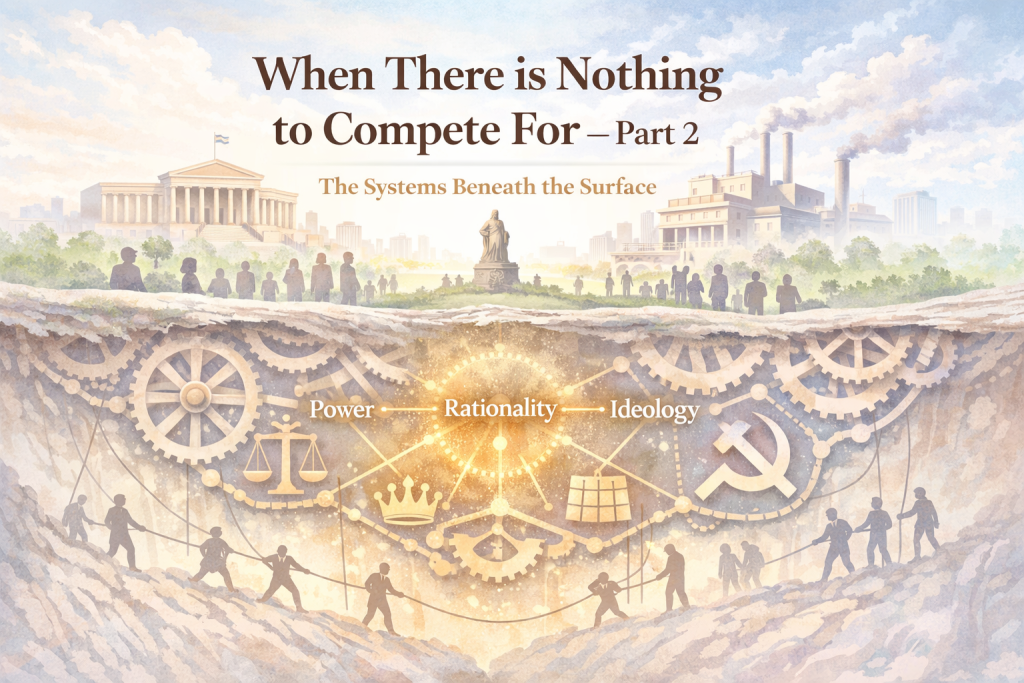
When people speak about the problems of a country, they often point to laws, institutions, leaders, or constitutions. Yet beneath all these visible structures lies something far less discussed and far more powerful. That is the system. Not the administrative network. Not the legal framework. But the way a society is made to think about itself, about power, about justice, and about what is considered reasonable.
A system is, at its core, a way of reasoning turned into practice.
This is why systems survive changes of governments, amendments to constitutions, and even revolutions. Faces change, rules change, texts change, but dissatisfaction continues. People sense that something deeper is untouched.
Every major political theory in history has tried to answer one question. How should human beings live together? From Plato and Aristotle to Locke, Rousseau, Bentham, Marx, Kant, and Rawls, the answers differ. Yet they all share a common foundation. They rely on rational reasoning as the ultimate guide. Each system proposes a particular idea of what is reasonable, fair, efficient, or just, and then builds institutions to enforce that idea.
This reliance on rationality is not a mistake. It was unavoidable. Human beings needed a common language to organize collective life, and reason appeared to offer that language. But rationality has a hidden weakness. It is never neutral. It is always shaped by perspective, history, interest, and power.
What appears rational to a ruler may feel deeply irrational to those who are ruled. What seems logical within a theory may become harmful in lived experience. This gap is not accidental. It is built into the very nature of rational reasoning.
History offers many examples. When political systems designed by great thinkers were introduced into new societies, they often arrived as complete packages. This was true of colonies under European rule, including Ceylon under the Colebrooke Cameron reforms. The utilitarian system introduced was coherent, disciplined, and theoretically aimed at maximizing social welfare. Yet it was alien to a society shaped by a different moral imagination and lived logic.
The resistance that followed was not merely cultural stubbornness. It was a clash of rationalities.
The same pattern appears even in countries that created their own systems through revolution. America, France, and Russia all turned to great thinkers to justify new political orders. Locke, Rousseau, Marx. Each offered a rational framework that promised freedom, equality, or justice. Yet each system soon required laws, institutions, and concentrated power to make society conform to that reasoning. The rulers and the ruled were once again pulled apart.
Democracy emerged as an attempt to reduce this distance. Constitutions followed, designed to restrain power and align governance with popular will. For a time, this seemed to work. But over time, new problems emerged. Situations changed. Interests shifted. Rational decisions made by those in power created unforeseen consequences.
Corrections followed. Amendments were introduced. Laws were revised. Administrative structures were adjusted. Each change aimed to fix a flaw. Yet each fix altered the system itself, often creating new problems that demanded further correction.
This process has no natural end.
What this reveals is something uncomfortable. Constitutional change is rarely the cure. It is the symptom. It signals that the underlying system, the rational framework guiding decisions, is under strain.
Philosophers were aware of this. Kant recognized the tension between theory and practice. Rawls tried to limit the damage of subjective reasoning by designing procedures that restrain decision makers. Others refined concepts of justice, liberty, or welfare. But none could escape rationality itself. They could only discipline it, soften it, or redirect it.
This is why no constitution can ever be final. And why no system can ever be perfect.
The problem is not bad leaders alone, nor poor drafting of laws. It is the belief that rational reasoning, when properly refined, can fully govern human society. History suggests otherwise. Rationality is powerful, but partial. Necessary, but insufficient.
When a society endlessly debates constitutional reform without questioning the system beneath it, it mistakes the surface for the source. Laws change, but the same logic continues to operate. Dissatisfaction returns, often deeper than before.
To understand why constitutions repeatedly fail to deliver what they promise, one must look beneath them. One must examine the system itself. The philosophy that defines what counts as reasonable, whose reasoning matters, and how power enforces that reasoning. Only then can a society begin to ask a more difficult question. If rational systems always carry this limitation, is there another foundation on which a political order can stand
02.1 Rationality as the Hidden Foundation of All Political Systems
When we speak about political systems, we usually describe them by names. Capitalism. Socialism. Liberal democracy. Marxism. Welfare state. Each name carries its own promises, fears, and historical memories. They appear to stand in opposition to one another, sometimes even as enemies. Yet beneath these differences lies a shared foundation that is rarely questioned. That foundation is rationality.
Every political system begins with an idea of what is reasonable. Reasonable behavior. Reasonable distribution. Reasonable freedom. Reasonable authority. From this starting point, the system defines what ought to be done and what must be prevented. Once these definitions are accepted, institutions are built, laws are written, and power is organized to ensure that this particular version of reason prevails.
Utilitarianism reasons in terms of maximizing happiness. Liberalism reasons in terms of individual rights and consent. Socialism reasons in terms of equality and planned fairness. Marxism reasons in terms of historical necessity and class emancipation. Even ancient political philosophies, from Plato to Aristotle, relied on reasoned visions of order and virtue. The conclusions differ, but the method remains the same. Rational reasoning becomes the silent authority.
This is why political debates often feel endless. People are not merely disagreeing about policies. They are defending different rational frameworks. What one group calls logical reform, another experiences as injustice. What appears efficient to decision makers may feel destructive to ordinary lives. These conflicts are not accidental misunderstandings. They are collisions between rationalities.
The danger does not lie in rationality itself. Human societies cannot function without it. The danger lies in forgetting that rationality is always partial. It arises from particular experiences, interests, fears, and expectations. It is shaped by education, class, culture, and historical moment. Yet political systems treat it as universal.
Once a particular rationality is elevated into a system, it demands consistency. Deviations appear as problems. Resistance appears as irrationality. Suffering becomes an acceptable cost if it can be justified by numbers, principles, or long term goals. This is how rational systems begin to distance themselves from lived human experience.
To protect itself, rationality requires structure. Laws define acceptable behavior. Institutions enforce compliance. Bureaucracies translate abstract ideas into measurable actions. Power becomes necessary, not because rulers are cruel, but because rational systems cannot survive without enforcement.
This is why even systems born with the language of freedom and justice slowly acquire mechanisms of control. Surveillance, regulation, discipline, and punishment are not betrayals of the system. They are its logical extensions.
Understanding this shared foundation changes how we see political conflict. It is not simply a struggle between good and bad systems, or progressive and backward ones. It is a struggle between competing rationalities, each claiming legitimacy, each incomplete, each capable of harm.
Once this is seen, a deeper question arises. If all political systems rest on rational reasoning, and if rational reasoning is inevitably limited and subjective, then what happens to the society that lives inside such a system over time
02.2 When Reason Rules, Power Follows
Once a political system is built on a particular form of rationality, something inevitable follows. That rationality must be protected, applied, and preserved. Ideas alone cannot do this. They need force, not
always violent force, but organized power.
This is not because rulers are naturally oppressive. It is because rational systems cannot survive in a world where human beings think, desire, and act differently. Rationality demands order. Order demands compliance. Compliance demands power.
At the beginning, power appears innocent. It takes the form of laws meant to guide behavior. Institutions meant to coordinate collective life. Procedures meant to ensure fairness. Everything looks reasonable, even necessary. Most people accept it because it promises stability and predictability. But rationality has a problem. It cannot tolerate persistent deviation.
When people resist a policy, the system does not ask whether its reasoning is incomplete. It asks how resistance can be reduced. When outcomes differ from expectations, the system does not doubt its logic. It adjusts enforcement. More regulation. Better monitoring. Stronger authority. Power grows quietly, step by step.
This is why every rational system develops bureaucracy. Bureaucracy is reason made durable. It translates abstract ideas into rules, forms, categories, and metrics. What cannot be measured becomes invisible. What does not fit the model becomes an anomaly. Over time, human lives are reduced to cases, numbers, and files, not because administrators are heartless, but because rationality demands simplification.
As power expands, distance grows. Decision makers become separated from lived reality. They act within models, forecasts, and expert advice. The ruled experience the consequences directly. What is rational at the top often feels irrational at the bottom.
To manage this gap, systems justify power morally. They speak of national interest, public good, security, progress, or historical necessity. These justifications are convincing because they are rational. They explain suffering as temporary, resistance as misguided, and control as unavoidable. This is how rationality and power reinforce each other.
Even systems that reject authoritarianism fall into this pattern. Liberal democracies rely on policing, surveillance, and legal coercion. Socialist systems rely on planning authorities and enforcement mechanisms. Revolutionary systems rely on exceptional powers to protect the revolution. The form differs, but the logic remains. When reason rules alone, power must follow.
This insight helps explain a familiar frustration. People feel that systems speak the language of reason but act with the weight of force. They feel governed rather than represented. They feel corrected rather than understood. These feelings are not failures of civic education. They are responses to a structural reality.
Understanding this prepares us for the next step. If power is not an accident but a requirement of rational systems, what happens when such systems are introduced into societies shaped by different moral and lived logics?
02.3 Alien Rationalities: When Systems Arrive from Outside
Political systems rarely grow slowly from within a society. More often, they arrive fully formed. Sometimes through conquest, sometimes through reform, sometimes through revolution, and sometimes through imitation. When this happens, a system brings with it not only institutions and laws, but an entire way of reasoning about life.
To those who design it, the system appears coherent and beneficial. To those who live under it, it can feel foreign, intrusive, and unsettling. This tension is not a failure of communication. It is a clash of rationalities.
The reforms introduced to Ceylon under the Colebrooke Cameron Commission illustrate this clearly. The utilitarian framework behind these reforms was disciplined, logical, and aimed at administrative efficiency and public welfare. From the perspective of British governance, it was rational and progressive. Yet to the people who had lived for centuries within a different moral, social, and economic logic, the system felt imposed rather than evolved.
This reaction was not mere resistance to change. It was a response to an alien rational order.
Utilitarian reasoning measures outcomes, balances costs and benefits, and prioritizes aggregate welfare. But societies do not live by calculation alone. They live by custom, trust, moral intuition, and shared meaning. When these are replaced by abstract criteria, even well intentioned reforms can feel violent.
Colonial societies across the world experienced this. Legal systems replaced customary justice. Centralized administration replaced local authority. Taxation replaced reciprocal obligation. Everything made sense on paper. Everything disrupted lived reality.
The same pattern appears beyond colonialism. Revolutionary states that overthrew old regimes often adopted systems inspired by great thinkers. America turned to Locke. France to Rousseau. Russia to Marx. Each system claimed legitimacy through reason and philosophy. Yet each required force to realign society with its rational vision.
In all these cases, the problem was not that the systems were irrational. It was that they were rational in a way that did not grow from the society itself.
Alien rationalities create a permanent tension. The rulers operate within the logic of the system. The ruled continue to live within their own moral worlds. Compliance may be achieved, but alignment remains elusive. Over time, mistrust grows. Resistance changes form. Legitimacy weakens.
This is why imported systems rarely feel like home. Even when they improve material conditions, they leave a sense of loss and displacement. People may obey, but they do not belong.
Understanding this helps us see a deeper truth. A system does not fail only because it is badly designed. It can fail because it does not speak the moral language of the society it governs.
This insight sets the stage for the next question. If systems create distance between rulers and ruled, even within democracies, how have constitutions and democratic mechanisms tried to close that gap?
02.4 Democracy, Constitutions, and the Illusion of Alignment
When the distance between rulers and the ruled becomes visible, societies instinctively look for ways to close it. Democracy emerges as the most powerful response to this problem. It promises participation, representation, and consent. It reassures people that the system speaks in their name.
Constitutions arise within this promise. A constitution is meant to be a bridge. On one side stands the system with its rational principles and long term objectives. On the other side stand the people with their diverse lives, fears, hopes, and moral intuitions. The constitution claims to bind them together by limiting power, defining rights, and setting rules for governance.
For a time, this works. Elections allow people to change rulers without violence. Rights protect individuals from arbitrary authority. Separation of powers prevents concentration of control. Courts act as guardians of fairness. All these mechanisms reduce the visible gap between decision makers and society.
But the alignment is never complete. Democracy operates within the system. It does not stand outside it. People choose representatives, but those representatives must still govern through the same rational framework that defines what is possible, affordable, efficient, or necessary. Choices are offered, but only within predefined boundaries.
Constitutions, too, are products of rational design. They encode assumptions about human behavior, social order, and power. They freeze a particular moment of reasoning into law. As society changes, those assumptions begin to strain.
This is when disappointment sets in. People feel that their vote changes faces but not outcomes. They sense that policies follow a logic that does not reflect their lived reality. They appeal to the constitution, expecting justice, only to find procedural answers to moral questions. The system remains intact, while frustration grows.
To respond, constitutional mechanisms are activated. Amendments are proposed. Interpretations are revised. Emergency powers are justified. Each step is taken in the name of democracy and legality. Each step is also a sign that alignment has weakened.
This creates an illusion. The illusion that constitutional change itself is progress. The illusion that a better text will resolve deeper dissatisfaction. In reality, these changes often manage symptoms rather than causes.
Democracy softens the distance between rulers and ruled. It does not eliminate it. Constitutions restrain power. They do not transform the rational foundations on which power operates. This is why even the most respected democratic systems remain restless. Debates over rights, authority, and reform never end. Trust rises and falls. Constitutional reverence coexists with constitutional fatigue.
Recognizing this is not a rejection of democracy or constitutions. It is an acknowledgment of their limits. They are tools of mediation, not cures. Once this is understood, a more uncomfortable question emerges. What happens when a system is repeatedly corrected through democratic and constitutional means, yet the underlying logic remains unchanged?
02.5 When a System Becomes a Patchwork
No political system remains the same over time. Even when its name stays unchanged, its shape slowly transforms. This change rarely happens through deep reflection. It happens through response.
A problem arises. A crisis unfolds. A conflict intensifies. Decision makers feel pressure to act. They introduce a solution that appears rational within the moment. Sometimes it responds to public demand. Sometimes it anticipates future threats. Sometimes it protects political survival. Each decision is justified. Each appears reasonable.
But each decision alters the system. What was once a coherent framework begins to stretch. A rule is added here. An exception is created there. A temporary measure becomes permanent. An emergency power quietly normalizes itself. None of these changes feel dramatic when taken alone. Together, they transform the system beyond recognition. The original logic that once held everything together weakens.
Over time, the system begins to resemble a wounded body. It carries scars from past decisions. Old wounds are covered with bandages of reform. Crutches of special provisions support parts that no longer function well. Plasters of amendments hold together structures that have lost internal strength.
Yet this system is still expected to walk. Rulers continue to govern through it. Administrations continue to operate within it. Courts continue to interpret it. Citizens continue to live under it. But no one can clearly explain what the system now truly stands for. Its principles are blurred. Its priorities conflict. Its outcomes surprise even those who manage it.
At this stage, rationality becomes defensive. When a problem emerges, the system does not pause to ask whether its foundation is sound. It searches for another correction. Another policy. Another amendment. Another restructuring. Each fix deepens dependence on fixes.
Public pressure accelerates this process. Citizens demand relief, protection, fairness, and recognition. These demands are legitimate. But when addressed through a wounded system, they produce further distortion. The system grows heavier, slower, and more contradictory.
This is the moment when constitutions come into sharp focus. Calls for constitutional change intensify not because society has discovered a new moral vision, but because the system can no longer carry its own weight. The constitution is asked to compensate for systemic weakness. It is stretched to justify contradictions, authorize exceptions, and legitimize emergency responses.
A new constitution is proposed. Or major amendments are promised. Hope rises briefly. But the underlying system remains the same wounded structure. The rational framework that produced the scars remains untouched. The new text inherits the old logic. The cycle begins again.
What people experience as constitutional failure is often systemic exhaustion. This is why debates about constitutions feel endless and unsatisfying. They circle around symptoms while avoiding causes. The system bleeds quietly beneath the surface, while attention is fixed on legal repairs.
To see this clearly is unsettling. It forces us to admit that survival through patching is not renewal. That correction is not transformation. And that no amount of legal refinement can heal a system that has lost its internal coherence. Once this is seen, the urgency of asking a deeper question becomes impossible to ignore. Can a system be built that does not depend on endless correction to survive?
02.6 Kant, Rawls, and the Attempt to Discipline Rationality
The weaknesses of rational systems did not escape the notice of great thinkers. Philosophers such as Kant and Rawls were not blind to the dangers of subjective reasoning, nor were they naïve about the gap between theory and lived reality. What distinguishes them is not that they rejected rationality, but that they tried to restrain it.
Kant recognized that a theory which cannot survive contact with practice is not a sound theory at all. His insistence that theory and practice must support each other was an admission that abstract reason alone is insufficient. Human action, shaped by context and moral judgment, inevitably challenges pure rational design. Kant did not abandon reason, but he acknowledged its vulnerability when translated into institutions and law.
This acknowledgment was significant. It meant that rational systems could not claim absolute authority. They required humility. They needed to remain open to correction. Yet even this openness did not solve the deeper problem. Correction itself was still guided by rational judgment, shaped by perspective and interest.
In the twentieth century, John Rawls confronted this issue more directly. He did not trust rational decision makers to act justly simply because they were intelligent or well intentioned. His response was not to eliminate rationality, but to place it behind constraints. The original position and the veil of ignorance were designed to limit how rational reasoning could serve power, privilege, or convenience.
Rawls hoped that by restricting what decision makers could know about their own position, rational choices would become fairer. This was a sophisticated and honest attempt to manage the dangers of subjectivity. Yet it also revealed a quiet admission. Rationality cannot be trusted to govern itself.
Even in Rawls, rational reasoning remains the foundation. It is merely disciplined, proceduralized, and insulated from certain biases. The system still depends on abstract reasoning to define justice, fairness, and legitimacy. The hope is that better design will reduce harm, not that harm can be eliminated.
This is the common thread running through the history of political philosophy. Each generation refines rationality in response to its failures. New concepts are introduced. New safeguards are added. New procedures are proposed. Yet the foundation remains unchanged.
The result is progress of a particular kind. Systems become more complex, more cautious, and more layered. They become better at explaining themselves. But they do not escape the limits that prompted reform in the first place.
Understanding this is crucial. It prevents us from romanticizing either the past or the present. The greatest minds did not fail because they lacked intelligence. They failed because they worked within the only framework they believed possible.
This realization prepares us for the final supporting essay of Part Two. If even the most refined attempts to discipline rationality cannot produce a final solution, then what does that say about our search for a perfect constitution?
02.7 Why There Is No Final Constitution
Every generation hopes that it will be the one to get it right. That with enough wisdom, consultation, expertise, and goodwill, a constitution can finally be written that settles the political question once and for all. History does not support this hope.
Constitutions are not born in a vacuum. They emerge from systems already in motion. They reflect the rational framework of their time, shaped by prevailing ideas about human nature, power, justice, and order. What appears balanced and fair at one moment inevitably becomes strained as conditions change.
This is not a failure of drafting. It is a consequence of limitation. A constitution assumes that the system it supports is sufficiently stable. It assumes that future problems can be anticipated. It assumes that rational safeguards can restrain irrational action. These assumptions hold only temporarily. Over time, subjective reasoning, shifting interests, and new pressures reshape how constitutional principles are interpreted and applied.
Amendments follow. Interpretations evolve. Exceptions multiply. Each change is justified as necessary. Each change moves the constitution further away from its original coherence. What was meant to be a foundation becomes a site of contestation. This process reveals a deeper truth. Constitutions do not correct systems. They adapt to them.
When the underlying system changes shape through patching, correction, and accumulated compromise, the constitution must follow. It stretches to legitimize what already exists. Calls for a new constitution often arise not from philosophical clarity, but from exhaustion. The old text can no longer carry the weight of the system built upon it.
This is why constitutional debates feel repetitive across countries and generations. Different words are used. Different fears are expressed. But the pattern remains the same. Hope, reform, disappointment, and renewed demand. The tragedy is not that constitutions fail. The tragedy is that societies expect them to succeed at what they cannot do.
No constitution can neutralize the subjectivity of rational power. No text can prevent a system from aging, mutating, and accumulating scars. No legal framework can reconcile every conflict between rulers and the ruled. This does not make constitutions meaningless. They are necessary. They restrain, mediate, and protect. But they are not the source of political health.
When a society places its hope entirely in constitutional reform, it turns away from a more difficult task. Examining the system itself. Questioning the rational foundation on which power operates. Asking whether another basis for collective life is possible.